Reflections on Rupert's life
By Terry Roopnaraine
Thank you for joining us here today, in this celebration of the life of my father, Rupert Roopnaraine. I am the first of a long list of persons who will be sharing their reflections on Rupert's life today. There are many, many things to say, and I will defer to others better placed to speak in depth about my father's political work. I will also leave aside the question of cricket, where his genes have clearly skipped a generation or two. And I will leave any discussion of QC days to Vic and Ewart. I will speak about what I know best, which is loving my father.
Growing up with Rupert—whom I have never called anything else—was an extraordinary privilege, and I recognised this from a very young age. Rupert's positions on child-rearing were—like so much in his life—informed by a very conscious process of applying reading to human realities. So the intellectual infrastructure of my childhood was shaped by the writings of Paulo Freire, AS Neill and other progressive thinkers on education and pedagogy. In practical terms this meant that as a child, I was listened to. I had rights. My thoughts and opinions carried a weight in our home which I now know was uncommon. My endless streams of increasingly pedantic questions received full attention and meaningful responses no matter what time of day or night they were posed. No topic was avoided or censored. I should probably note here that when my parents eventually divorced and I went to live with my mother, she inherited these expectations and continued to put them into practice—a challenge I now appreciate more than I did at the time, given that she was at that point in the throes of writing her PhD dissertation.
Rupert loathed the idea of age-appropriate vocabularies, and felt strongly that children should never be spoken down do, or patronised with simple language and short words. I recently found a letter Rupert wrote to me in 1976, when I was 9 years old, in which he explained in detail how a film-making project was increasingly becoming an act of political resistance. As he put it at the time, "We are going to give Mr. Burnham a lesson in dialectics". Rupert believed and taught that language matters because it is one of the most important tools for liberating the human spirit—this being as much a truth for children as for adults.
Language of course was not only political for Rupert—though obviously that was a central feature of his engagement with it. Possessed of an extraordinary aesthetic sensibility, Rupert felt strongly that language—in the broadest sense of that word—could and should be as much about generosity and beauty as about the austerities of signification. To share a home with Rupert was to inhabit an animistic world, where words and images—in books and paintings, photographs and films—took on magical qualities, not only enriching our lives, but becoming living co-conspirators in the quest for a better world.
In the autumn of 1976, I moved into a house on East Street with Rupert, Lewanne Jones, Ray Kril, a sound engineer called Susumu Tokunow, and a huge collection of books, shipped from Ithaca, NY in large wooden crates. One of these crates was converted into a terrarium where my small boa constrictor lived. I should add here that Rupert managed to put aside his own antipathy towards snakes so that my fascination with them would have room to grow, quite literally.
For the next several months, this nucleus of the Victor Jara Collective—named for the revolutionary Chilean musician murdered by the Pinochet regime—completed the filming of The Terror and the Time, a film which went on to become a classic of radical cinema, locating the anti-colonial struggles of 1950s Guyana within a broader and more global interrogation of the inhumanity and hubris of empire. The film was framed through the lens of Martin Carter’s Poems of Resistance, and was part of a decades-long conversation with Martin Carter, as reader, friend and critic. For my part, I briefly attended St. Margaret’s at that time, until Rupert decided that I would learn more fetching tripods on the film set than in any classroom. This period, now five decades in the past, is engraved in my mind as a time of wonders and excitement. The Terror and the Time opens with a quotation from Fanon and the music of Keith Waite, segueing into Martin Carter reading Cartman of Dayclean as the eponymous cart driver moves across the screen in the new light of the breaking dawn. It is a remarkable piece of cinematography and an establishing moment for the film, but when I return to it, what I see is all of us pulling the equipment out of the old Land Rover, before dayclean in Windsor Forest, setting up this shot on a muddy track in uncooperative natural light. The excitement comes washing back over me, and I now understand that Rupert’s insistence on my being part of all this was about helping me to recognise that films and books and art do not arrive to do their work fully-formed, but as the hard-birthed products of human creativity and endeavour. The follow-on lesson being of course that real social change is always grounded in production.
As Rupert became increasingly engaged in oppositional praxis through the second half of the 1970s, Guyana was becoming an ever more dangerous place. It says something about the risks of the time that he felt I would be safest going to school outside Guyana—‘outside Guyana’ in this case being Jamaica, where my mother was teaching at UWI. Friends of a certain age will know that Kingston wasn’t so safe either, in the late 1970s. My father and I treasured my visits home in the holidays and it was only years later, as an adult, that I was able to appreciate the complex balancing act he performed to ensure my visits were as ‘normal’ as possible. In truth, there was nothing remotely normal about this situation, and with forty-odd years of hindsight, I am amazed at Rupert’s ability to reconcile the demands of loving fatherhood and political activism. As his son, I experienced a growing awareness of what Rupert was doing, and why he was doing it in spite of ever-clearer threats to life and liberty. I am grateful to this day for the time and care which he took to explain these things to my 12-year old self.
In 1990, I finished university and joined Rupert in Guyana. He had recently moved into what was then a small, off-grid cottage located on a mosquito-infested coconut estate lying between Unity Village and Mahaica. Through the 1990s, he expanded Tranquillity Hall, filling it with books, paintings and sculpture. Politically, this was a time of transition, from an insurrectionist to an electoral mode. Aesthetically, it was a time of great creativity, when Rupert was free to pursue further writing and film projects. For me, it was a crux moment, an opportunity to engage with my father as an adult. Sharing readings, writings, and reflections, I was able to grasp for the first time the profound parameters and distant horizons of my father’s intellectual world. One of my life’s greatest regrets is that Rupert’s grandchildren—my children and Alicia’s—will never have the opportunity to experience this in the way I did.
I said at the beginning that I would generally leave political matters to other speakers on today’s programme. I would, however, just like to make a small observation about Rupert’s way of ‘doing politics’ during what we may call his Parliamentary era. This is the fact that, however political he may have been, Rupert roundly rejected the label ‘politician’ and the many negative tropes which he associated with it. For Rupert, there was certainly important political work to be done in Parliament—enacting laws and policy, scrutinising budgets and the like. But his real pride and joy in political life lay in the work of representation. He was fascinated by the granular details of people’s life experiences, and I have lost count of the occasions when he was approached in the street or on the way home, by people who had been stonewalled and disempowered at offices and ministries while struggling to resolve one crisis or another. Rupert would always listen respectfully, noting their accounts in a small black notebook, so that he could raise their concerns in the right place, facilitate access as needed, and do his best to resolve problems, however mundane they might appear. For Rupert, this was the real accountability of politics, and the politics of accountability; he understood instinctively that issues impinging on real human lives are often much less trivial than they appear when viewed from above. In this line, he also understood that true emancipation isn’t just about reforming institutions and promoting democracy, but about unleashing the everyday genius and creativity of the human being.
Growing up with Rupert was an amazing, complicated, enriching experience in more ways than I have time to describe here. But to take refuge in a much simpler truth, what I will miss most of all is his unquestioning and unconditional love.
I have spoken enough and will hand over to my sister Alicia now. Before I do so, I would like to express my gratitude for the love and care which Alicia, my brother-in-law Jahir, and their family have lavished upon Rupert over the past several years, cushioning the effects of his declining health. Their care has been a huge source of comfort for me when I have been far away from Guyana. I also know that Rupert took enormous joy from sharing Tranquillity Hall with his youngest grandchildren during this time.
Finally, on behalf of our entire family, I would like to personally thank Minister of Health Dr. Frank Anthony, as well as the medical and nursing staff of GPHC and Enmore Hospital for providing care and expertise when it was most needed.

By Karen de Souza
I want to remember a few snippets of my engagements with Rupert that are not often, if at all, spoken about. We can read about all his public achievements and contributions as politician, his brilliant scholarship and creativity, but equally impactful were his small displays of kindness and concern for others, and the care he showed for his community in concrete, intentional ways.
I first met Rupert when I was thinking of leaving the university after being there for a year and he influenced me to stay on. His classes were a joy- challenging, informative and very relaxed - no stiff formalities. They were an eye-opener as to what university could be: a place of collective care, where the generation of knowledge is not based on exclusion, but on ensuring each person had the means to participate.
Rupert saw the necessity of this. He organised classes at his home to reduce travel costs for his students, and offered housing to one student who was paying for lodging to attend the university.
He also inspired- in myself and others, in his students- an appreciation of the colonial history of Guyana, and the history of and the possibility of resistance to the colonial powers. I spent many hours, on and off campus, organising viewings of his documentary Terror and the Time, the story of the Guyanese people's fight for independence and self-determination,produced by the Victor Jara Collective - this is a documentary that should be universally viewed in Guyana, particularly in these times.
Rupert did not just teach about the politics of resistance and solidarity; he practiced it. Recognising that the young people volunteering at the first WPA centre had no income and spent most of their days in the centre or out organising, he committed to raising donations so that we could have a meal of bread and cheese and fruit every day - a veritable feast in those days.
I still laugh when I remember Rupert and Walter tiptoeing out of the centre to escape Brian Rodway’s, WPA’s graphic artist and chief printer, rage about their lateness to deliver materials he was waiting for.
Rupert’s community began with and was rooted in his family; he loved children, and his joy in the grandkids, Victor and Diego, Jaden, Kareem and Katerina was tangible.
Thanks to the community of carers that convened at Mahaica.
So walk good Rupert. I send you some lines from Martin
….
My course is set, I give my sail the wind
To navigate the islands of the stars
Till I collect my scattered skeleton
Till I collect.

RUPERT
By Vic Insanally
I get a spot on this morning’s programme, because I am Rupert’s oldest friend alive in Guyana. The only other one I know to be alive for sure is Professor Winston Mc Gowan. I am glad to have the company of Dawn Holder Cush, a Queen’s College Alumna and whose father was a very close friend of Rupert’s –Terry Holder who passed a few years ago.
I am grateful for this opportunity to offer the collected condolences of all Queen’s College alumni - many scattered around the world in Canada, the Caribbean, UK and USA and particularly those from the golden decade of the 1950’s – condolences to Terry and Alicia and their families, Bob – Rupert’s only younger brother in Mauritius, to Jocelyn, Vanda, Danuta and all of the faithful crew of admirers from the WPA, the party he co-founded with Walter and who have honoured Rupert with this lovely setting here today.
We are here to mourn, to celebrate a life and legacy and to say so long. So much has already been said about that legacy, that will be repeated today. There’s no shortage – check out Nigel Westmaas’ tribute – search for a copy of the Time and the Terror – a film that he directed when he formed the Victor Jara collective in the 1970s – read his poetry, his work on Martin Carter and Stanley Greaves, get a copy of his book “The sky’s wild noise”.
Maybe out of all of this and all that happened in the struggle before, you can mesh the two narratives and produce an RRR – Remembering Rodney & Roopnaraine. I am excited about the possibility of continuity, as Rupert’s son Terry with a Doctorate in Anthropology and my daughter Sarah, with one in Public Health and Development are contemplating the formation of a Think – Tank with the acronym PROPEL to be based in Guyana.
Throughout his life, Rupert always had the good fortune of having a support group of family and friends who would be there for him. In the beginning it was his parents – two people I have always known as Crumpy and Penny, who, wanting to ensure that he got off to the right start – decided to invest hard earned cash to enroll him in a private school with the sole purpose of Rupert winning a scholarship to get a free place at Queen’s College.
The year was 1952, Rupert was 9 and I was 10. The family moved down from Kitty to one block away in First Street Alberttown from where I lived. The school was ambitiously named the British Guiana Education Trust College. Its home was a relatively old two-storied building (the LCP hall) on Charlotte Street, between Camp and Wellington. Cheddi Jagan had just opened his dental surgery two doors away. Jessie Burnham ran a cake shop next door where you could get a small lemonade for three cents! And Calvin Whyte’s Invaders steel band used to practice across the road.
I was already there when Penny decided I would be Rupert’s big brother – a role I didn’t mind as it had many benefits. I sat the Government County Exam in 1953 and just made it to Queen’s – the PPP victory and the Queen’s Coronation made several extra scholarships available and the likes of Walter Rodney, Walter Ramsahoye, myself and others to get in to Queen’s. A year later, Rupert easily passed without any fuss.
The close relationship continued for the next six years – both of us majoring in the classical languages. Rupert excelled in cricket as an off-spinner and captain of the school team. He went on to win the Guyana Scholarship in 1962. I met him in London, we spent two nights together in Clapham Common before he went up to Cambridge. Ewart Thomas, one of the brightest of our time will continue the story in his tribute.
In the early hours of last Monday morning, Terry and his wife arrived just in time to rush him to the Public Hospital – where death came as a friend, to take him. My hope – my belief is that Rupert’s spirit, his soul will go marching on.

Essence of Rupert
By Ewart Thomas
My name is Ewart Thomas. I hope that our attendance and our messages today will be as an abiding balm to Rupert’s family, especially those, like Jocelyn Dow, who cared for him, lovingly and unstintingly, during the last, quiet years of his life.
Rupert and I shared many of the experiences that defined our formative years – the high school years at Queen’s College during the 1950’s, and then a few years in the mid-1960’s at Cambridge University. The major political events of 1953 set the stage for the education our generation at QC received inside and out of the curriculum. This experience, I believe, is a major source of the arc that led Rupert, fifteen years later, to his political activism in Guyana alongside Walter Rodney and others in the Working People’s Alliance.
My friendship with Rupert really started when I arrived at Cambridge as a graduate student in 1963, the year after Rupert got there. The joyfulness of his welcome, and the generosity with which he introduced Cambridge to me, were invaluable as I adjusted to the difficult mathematics in the classroom, and the traditional English reserve in the extra-curricular spaces.
But the instruction for which I was most grateful was Rupert’s informal guidance in that interdisciplinary mix of literary and social theory now known as Comparative Literature. He introduced me to canonical texts that had eluded me, and to exciting new cultural products, such as the French New Wave films. I will always be grateful for those tutorials.
This week I learned that this Rupert effect was felt by many others whose prior education was much broader than mine. I heard from Mike Brearley, who lived in the same house as Rupert in the 1963-64 year. Mike will be known to many of you, in the words of a 2015 article, as “England’s greatest-ever cricket captain.” But more relevant to my point is the fact that Mike was a distinguished student at St John's College, where he read Classics and Moral Sciences, and achieved a first-class degree in Classics. There is breadth and depth here. And yet, according to Mike: “[Rupert] was far more advanced and adventurous in his thinking and speech than me and many other naive British undergraduates of the time.”
We were a small, distinguished group of Guyanese students orbiting around Rupert, including Miles Stoby, Walter Ramsahoye, James Croal and Wilfred Sewchand, and we dearly wanted Rupert to earn his Blue in cricket. This he did in 1965, despite our concerns and those of his captain that his penchant for bridge, a wholly nocturnal pastime, would interfere with his physical conditioning.
Our concerns started during the 1964 game at Fenners between Cambridge, with Mike as captain, and the touring Australian side, with Bob Simpson as captain. Cambridge batted first and scored 251, and then bowled the Aussies out for 346. Rupert bowled 30 overs, getting 2 wickets for 69, including that of Simpson, stumped for 95. Late in the day, Rupert got cramp in his legs, and they virtually had to carry him off the field. As he was being celebrated that day as a wounded warrior, Mike couldn’t resist suggesting to Rupert “that playing bridge all night was not necessarily the best preparation for a top-class athlete!”
That year, Deryck Murray came to Cambridge, and he was Rupert’s captain in 1966, when Cambridge played the West Indies, with Gary Sobers as captain. In that game, Rupert bagged 2 wickets for 88, including Gary’s, lbw for 83. But this time he had to bowl 35 overs to get his results – and yet, there were no reports of casualties. Was it that a lesson was learnt, or merely that Rupert was 2 years stronger? I spoke to Deryck this week, and he was emphatic that there was absolutely no diminution in Rupert’s passion for bridge, although he did concede that Rupert may have been better nourished in 1966!
In the midst of all this joking about cramping, memories resurfaced, unbidden, of the causal forces actually in play during that 2-year period. They can be summarized in two words: Suraiya Ismail! The two were married in the middle of this period, and I served as Rupert’s best man.
I imagine Rupert, in the last stages of his flight home to the ancestors, picking up a couple of comrades, Suraiya, Andaiye, Walter and Ohene.
Rest in Peace, my Brother!

A Celebration of the Life, Scholarship, and Activism
by Wazir Mohamend
As we gather to reflect, reminisce, and celebrate the life of my brother, colleague, and comrade Rupert, I want to share a few personal reflections—tidbits from my experience, up close and personal.
Rupert—affectionately known as “Rups,” and to his parents, Crumpy and Penny, simply “Rupee”—was a pillar of the Working People’s Alliance (WPA). After Walter Rodney’s assassination in 1980, Rupert quite literally took the helm of the WPA. Among close frontline activists at the time—Karen De Souza, Nigel Westmaas, Victor Kersting, and others—he earned the quiet title of “the helmsman.” Though leadership in the WPA was collective, Rupert became the de facto leader, guiding the executive and later serving as co-leader.
From the time he reentered the political scene in 1976, his mission was clear. In an essay in The Sky’s Wild Noise, he wrote: “In the end and in the beginning, the task before us is national reconciliation. A necessary precondition is a national conversation on race.” That conviction guided him throughout his life. He believed firmly that existing state mechanisms—whether the Ethnic Relations Commission or its predecessors—were insufficient for the deep healing Guyana required.
Rupert dedicated himself to the unfinished task of reconciliation. He was at his best in the presence of Guyana’s diverse communities—African, Indian, Indigenous, and others—and he consistently encouraged them to act in concert. When the history of the period 1970– 2026 is written, Rupert’s unwavering commitment to a multi-ethnic future for Guyana— though not yet fully realized—will shine brightly. That is a legacy for current and future generations to ponder, critically appraise, and claim.
He believed Guyana’s future depended on a National Government representing all its peoples, and he worked tirelessly toward that vision. This work is catalogued in the initiatives he led or shaped:
- In the late 1970s, alongside Walter Rodney and others, he advocated for a
- Government of National Unity and Reconstruction.
- Between 1986 and 1992, he was at the forefront of the WPA’s struggle to unify the opposition around the demand for free and credible elections.
- In 1990–91, he led talks with President Hoyte for a caretaker government to oversee free and fair elections—an initiative acceptable in principle to the PNC, though it did not gain full opposition support. After the 1992 elections, he again implored the PPP to pursue a national government; again, that effort faltered.
- In 1999, he immersed himself in the constitutional reform process, which brought meaningful—though limited—changes. He saw it as a beginning, not an end.
- During the crisis of the early 2000s—what he described as a period when Georgetown and nearby villages were turning into a killing field—Rupert could not accept the existence of phantom death squads or the extrajudicial killing of hundreds of young men. His call for reconciliation intensified with urgency.
- Around 2010, in private conversation, he spoke to me about rapprochement with the PNC—a process that would ultimately contribute to the formation of APNU. Whether one agreed or disagreed with tactical decisions, Rupert’s compass was always pointed toward national healing.
Rupert was a thinker-activist who placed the people’s interests above his own. He was selfless. And he was deeply loved.
He was welcomed and housed in communities across the sugar estates, bauxite towns, rice- farming villages, Indigenous communities, and urban centers of Guyana. Among them were Madan and Baba Pydiah of Leonora—militants in the sugar industry—who opened their home to him; and whose home hosted the inaugural meeting that brought sugar and bauxite workers together under the Sugar and Bauxite Workers Union Committee in the early 1980s.
I also remember Sumdat and Baby of No. 67 Village, Corentyne, whose home became, in effect, an annex of the WPA. From there, Rupert monitored state attacks on rice farmers. I recall vividly his pain one Saturday morning when Rosie, the 13-year-old daughter of Rohit Ramcharran of No. 57 Village, was arrested because her family possessed more rice than the law allowed.
Without taking away from Rupert’s prowess as an internationalist fighter, the context of the role of some of the players abroad-the long list of WPA and Rupert Supporters must be noted, among the long list are: Life-Long friend and confidant-Lincoln and Savitri Vansluytman who were central in Rupert's life, as were Mark and Kamal Matthews, Miles Stoby, Kojo Nnamdi, Luke Daniels and others, and the special role of Errol and Kumarie Arthur—who opened their home and resources to support the editing of the film Maha
Shiv Ratri.
Rupert stood among many, and he stood tall.
I first encountered Rupert in August 1979, when he brought greetings from the WPA to the PPP’s 20th Congress at Anandale Secondary School. At the time, I was a member of the PPP and its youth arm, the PYO.
Later that year, Rupert, Walter Rodney, Andaiye, and Bonita visited our family compound at Ledestein. Our elder, Mr. Rahman—a longstanding PPP associate—immediately warmed to Walter and Rupert. That visit marked the beginning of our family’s deep relationship with the WPA. Rupert became part of our family.
One morning in February 1980, I was having breakfast with Rupert and Walter at his New Garden Street home. They asked me why I was not working full-time in the WPA. That morning, I made the decision to leave my job and commit myself fully to the struggle. After Walter’s assassination, our bond deepened. I moved into Rupert’s New Garden Street home, and for six to seven years we shared a dwelling.
During those years, Rupert developed a deeply respectful and politically intimate relationship with Eusi Kwayana, who was more than a colleague—he was a mentor, elder brother, and moral compass to many of us. Many nights Rupert would knock on my door and say, “Waz, you up? Come, let we go to Buxton.” Kwayana’s living room became a site of late-night conversations, strategy sessions, and careful planning as we pressed forward the struggle for democratic rights.
When his health began to fail in 2016, Rupert called and asked me to assist him in the Ministry of Education. When I asked why he chose me, he said, “Waz, you know me more than many people. I want someone who would bring my culture—the WPA culture—into the Ministry.”
That was Rupert: loyalty of purpose rooted in shared struggle.
Let me end with this.
Rupert was not merely a Guyanese revolutionary and patriot. He was part of a generation of intellectuals from the Global South who returned home after studying abroad to shape the politics, economy, and culture of their countries.
Time does not permit a full accounting of his international engagements—his deep and personal relationships with Maurice Bishop and the New Jewel Movement; his work with Desi Bouterse of Suriname and the Suriname–Guyana Friendship Society; his personal friendship with Luis Ayala and his involvement in the Socialist International; his solidarity with the Cuban Revolution; and his efforts to build bridges among Caribbean left movements.
I must also mention his dear friend and comrade, Horace Campbell-who was also a friend of Walter Rodney and teaching colleague at Cornel-and as the history of the WPA will record, on Rupert’s suggestion, Horace became the lone non-Guyanese inducted into membership of the WPA to pilot WPA’s entry into the Socialist International, represent the party at its meetings, and other international forums.
I am better because Rupert was my close friend.
Together with Eusi, Bonita, Moses, Andaiye, and others, we shared a bond forged in struggle and sustained by love and respect.
Rupert was a son to my mother. A friend and comrade to my brother Ameer. He was family at Ledestein. He was uncle to our sons, Aqib and Abdil. Sharmela, the boys, and I will forever cherish our memories of and with him.
To Jocelyn Dow—the proverbial mother of the defiant generation—thank you for being a pillar of strength, especially in Rupert’s final years. And to Terry, Silke, Victor, Diego, Alicia, Jahir, and the children—thank you for sharing Rupert with all of us.
It was, indeed, a life well lived.
And as we part with his mortal remains, let us remember his consistent concern about literacy in underprivileged communities, and expanding inequalities, including in Indigenous communities.
As Minister of Education, he was less concerned with grand buildings than with the training of teachers, culturally relevant curriculum, and textbooks rooted in Guyanese mythology and history.
He advocated for the University of Guyana to become a leading world-class institution— governed by a nonpartisan and independent council and resourced adequately to thrive. He supported the teaching of Indigenous languages in schools and championed the inclusion of music instruction in every school.
The now-active bilingual Wapichan/English program for Wapichan children and leaders in the South Rupununi stands among his signal achievements as Minister of Education.
He left us a rich and enduring legacy.
My brother, we will meet on the other side.

By Stanley Greaves
It was in 1977 that Rupert Roopnaraine walked into my office at the University of Guyana. He looked at me as if he already knew me. After introducing himself as joining the Faculty of Arts to lecture in Literature, he proceeded to describe a particular painting of mine I had done in 1955 entitled Evolution, which belonged to Dr. Frank Williams. To state that I was astounded is putting it mildly. It turned out that he was a friend of Andaiye, the daughter of Dr. Frank Williams. Roopnaraine said that he used to see the painting in her home, wondering what it was all about. Dr. Williams had asked me to do a painting based on the History of the World by H.G. Wells, which was one of his favourite books. In subsequent conversations with Rupert, he provided the background to his being in Guyana. We had interesting conversations about art and literature and the position they held in the Creative Arts.
At the University, the students had great respect for Dr. Roopnaraine and were invited to his home to have discussions and free access to his library. I once saw him lecturing under a tree near my office.
Because he was interested in Visual Arts, a group which included Rupert, Jocelyn Dow and Vanda Radzik formed the Dorothy Taitt Foundation in an effort to support local artists and acquire and retain significant pieces of artwork that were housed at what is now Cara Lodge.
During a period when he took leave from being actively involved in politics, he decided to write a book about my work. He was given access to my journals and photographs. I later suggested that the book should be entitled Primacy of the Eye. A child sees and experiences things before it talks. In 2005 it was published by Peepal Tree Press, owned and managed by Jeremy Poynting.
In the early 1990s, Roopnaraine had the idea of interviewing artists in the Caribbean and formed a group including Ray Kril, a filmmaker. My role was to conduct the interviews. We started first with Guyana followed by Trinidad, Barbados, Curacao, and Cuba.
Because of his deep personal interest in my work, Rupert Roopnaraine also became involved in writing catalogue notes for most of my exhibitions held in the Caribbean. His scholarly writing paid attention to my intentions and more importantly, presented informed perceptions to my work. I remain totally indebted to him for the sustained openness and reliability of his friendship.
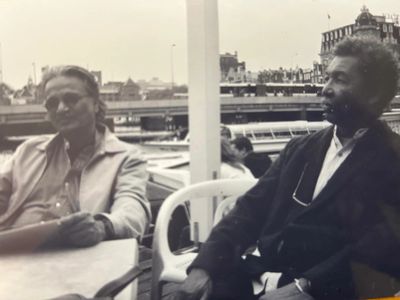
Rupert Roopnaraine, Some Reflections
By David Abdullah
I join with so many others in saluting Rupert - a friend and comrade - and give thanks for all that he contributed to this world. I first met Rupert on my first visit to Guyana. The year was 1980 and Walter, Rupert and Omawale were on trial for arson – the burning of the PNC Secretariat. In Trinidad and Tobago we had a solidarity group – the Committee Against Repression in Guyana (CARIG) which was comprised of leading members of the trade union movement and progressive sisters and brothers, one of whom was PI Gomes. CARIG was asked to send a representative as an Observer for the trial and I was the designated rep.
Allan Alexander was one of the progressive regional attorneys who were going to be part of the defence team and Allan and I travelled together to Guyana late on a Saturday evening. We both stayed at Rupert and Bonita’s home. The Sunday afternoon I had a private meeting with Walter and later attended and spoke at a public meeting in Georgetown organised by the Guyana Human Rights Association and others. By Monday the police and immigration were looking for me and after going to the Brickdam station with my attorney Moses Bhagwan – who was physically prevented from representing me – I was taken to the airport to be deported. My error was to tell the police that I had to collect my bag from where I was staying and thus – inadvertently - exposed Rupert’s “safe house”. He never condemned me for my naiveté.
My next encounter with Rupert was when he came to Trinidad for the Memorial for Maurice Bishop and the other martyrs of St. George’s which we organised in December 1983. We had a long debrief with the Comrades who came from afar for that Memorial, the only one that Maurice’s mother and sister could attend. George Lamming gave the Tribute as he did for Walter before and for CLR later on. My memory says that Rupert also came to Trinidad for CLR’s funeral.
Thereafter, Rupert was a regular at activities that the progressive movement in Trinidad organised. He never said no, such was his commitment to sharing his wisdom and contributing to movement building. Sometimes he stayed at my home and later on at Cara Suites given its Guyanese links. He gave a Feature Address at an Annual Conference of Delegates of the Oilfields Workers’ Trade Union, attended our major anniversary events and presented at several education seminars, one of which stands out in my mind. It was the 30th anniversary of the 1969 “Rodney Riots” in Jamaica when the Jamaican working class with whom Walter “Grounded” exploded in anger at Walter being banned from entering the country by the Shearer led JLP government following Walter’s attending the celebrated Black Writers’ Conference in Montreal. This two day conference that I organised at the OWTU examined what happened to the working class mass movement in those 30 years as we moved from mass protests to criminal gangs. Rupert and Brian Meeks were the two regional presenters.
Rupert’s last intervention was in the formative stage of the Movement for Social Justice. A few comrades and I had been working on building a new progressive party and brought together some youth, trade union activists and older political comrades in the “Collective”. Rupert came to Trinidad for a one day session in 2007 at which he and Norman Girvan were the presenters. Rupert’s afternoon session got cut short as we all had to attend Lloyd Best’s funeral.
I visited Guyana a couple of times after Rupert was in government and the Minister of Education. I made sure to make every effort to see him. On the first occasion he was terribly busy with his ministerial responsibilities but we met at Cara Lodge where I, of course, was staying. He said it was important work but having to deal with very many issues was a huge challenge. I also made sure to visit Andaiye on that visit and Rupert got his driver to take me there. Regrettably, I missed seeing him at the Bocas Lit Festival in Trinidad in 2013 when he won a prize.
On my last visit to Guyana for a one day conference organised by the CARICOM Secretariat I contacted another friend – Tony Farnum – and we drove out to see Rupert at his home. We had a good and, as it turned out final, gaffe. I, like so many others, am honoured to be able to say that Rupert Roopnaraine was not only a Comrade but a friend! And in doing so, it struck me that all the persons named but four are no longer with us. They were from a generation of revolutionary Caribbean thinkers and activists who are all missed but their legacy lives!

Reflections on Passing of Dr. Rupert Roopnaraine
By the Executive Committee of the Guyana Human Rights Association
Wondering where to start reflecting on the many-faceted life of Rupert Roopnaraine led us to begin at the beginning, so we went to the Walter Rodney Archives to look up the newspapers, for the day of his birth.
Excited headlines of the Daily Chronicle for January 31 1943 trumpeted the decision to convert Atkinson Field into a civilian airport for ‘Georgetown’ – it eventually materialized two years later. Dominance of the news by the Second World War was reflected in a competition for the best slogan entitled “Careless Talk” for which the Bureau of Publicity and Information announced receiving 3,517 entries.
More mundane news included a police Sergeant being charged for stealing a bed-sheet valued at $1.10, the property of ‘the inhabitants of the colony of British Guiana’. A Port Mourant businessman reported the theft of a tin containing $180. he had buried under his house. He claimed to have employed this “novel method for some time, but went this morning to find the tin empty”. Cigarettes worth $5.00 were stolen from Sydney Callender’s shop and on the same night Mr. Gonsalves shop on Evans and Russell Streets was broken into, but “the thieves were disturbed and scampered away’. A donkey-cart owner/driver was charged for working his donkey in an unfit condition. The Magistrate went into the courtyard to examine the donkey, berated the driver for treating the animal so cruelly and sentenced him to 21 days in prison.
The owner of the Peacock Bakery in Saffron Street was charged with selling bread above the fixed price. He sold 122 ounces of bread for $1.92, his defense being that he never intended to sell the bread to anyone, it was to be given to Brickdam Presbytery. SEMCO cycle shop took out an ad stating its rates for hiring men and women’s cycles would not be part of a racket to raise prices. “Unless Hitler wins the war” prices would remain at .6c per hour for female cycles and .8c for males. A.J. Seymour gave a lecture at the Library Discussion Circle entitled “Capital” by Karl Marx. The Legislative Council recommended that the Bishops high School should be separated off from Queens College and be funded by the Government. Finally, 158 teachers were taking a refresher course in needle-work at the Carnegie Institute.
While we read the above with a degree of amusement, we are only able to do so because the hardships they disguise are air-brushed out of the picture. How was a police sergeant so desperate as to steal a bed sheet valued at $1.10c? Compare that with another piece in the Daily Chronicle about a commotion among members of the Georgetown Cricket Club, over the fact that GCC had to bear the expense of Inter-colonial cricket matches - reflecting the gulf between life-styles of the average person and the elite.
What emerges from these vignettes of life in the 1940s is how attentive the society was to laws and processes even in matters which now seem of little consequence. Significant public funds were devoted to maintaining law and order on infractions in the poorer districts of the capital city. While this may reflect class-related issues it cannot be all be dismissed as discriminatory. It also reflects regard both for the role of the law and the need for humanitarian values, even with regard to animals. Which magistrate these days would spend time inspecting the treatment of donkeys?
Nowadays we are ready to set aside considerations of principle, reducing the significance of actions to the wealth of the persons involved. This routinely jettisons the impartial application of laws and rules.
Why do these considerations belong in reflections of the life of Rupert Roopnaraine?
Rupert Roopnaraine’s political activism was driven in large part by recognizing that inequality was not simply a financial matter to be corrected by hand-outs in the form of school uniform, housing subsidy, cash grants and the like. Such thinking overlooks how deeply humiliating this attitude is for recipients. He recognized that rather than be on the receiving end of such kinds of assistance, the only way to eradicate poverty without humiliation is to recognize a full range of social services as rights, working people have a right to pensions, to decent housing and to health services, embodied in law and constitution. It is not humiliating to receive what is owed to you as a right.
One of Dr. Roopnaraine’s enduring contributions was to strengthen awareness of the link between poverty, inequality and human rights, culminating in his work on the reformed Constitution of1999-2000 in which the GHRA collaborated closely with him. The current obsession of right-wing/fundamentalist politics equates progress with privatized prosperity, an approach diametrically opposed to what Rupert Roopnaraine’s political career stood for: namely a public sector whose goods and services promote our collective identity and common purposes, recognition of welfare as a matter of right and its provision as a social duty. Unlike most of us Dr. Roopnaraine paid attention to the cost of social humiliation.
From a society which was largely complacent about its inequalities at his birth, Guyana on his death is coming to believe its economic problems can be solved by money– no matter the social cost in terms of alienation and humiliation. Rupert’s contribution to the search for a principled solution to the on-going issue of inequality tends to be overlooked; not only for his keen intellect but for his capacity to bring polarized people together and reduce confrontation of all kinds with wit and humour. An approach badly needed across the society.
His contribution will be solely missed.
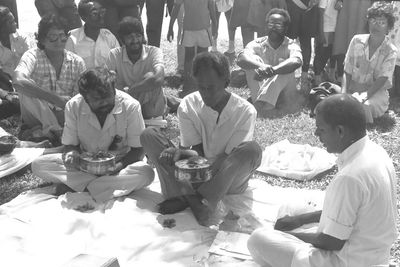
Respect at the Passing of Dr. Rupert Roopnarine
By President Irfaan Ali
I join in bowing my head in respect at the passing of Dr. Rupert Roopnarine, and I extend heartfelt condolences to his beloved family, his friends, and his comrades in the Working People's Alliance, which he co-led with uncommon courage and intellectual grace. Guyana has lost a public figure of conscience.
While we sat on different sides of the political aisle, I have always regarded Dr. Roopnarine as belonging to that rare fellowship of men who wed thought to action and principle to sacrifice, especially during the testing years of the anti-dictatorship struggle. When the air itself seemed heavy with fear, he stood upright. He faced persecution not with bitterness, but with resolve. Alongside his comrade and friend, the late Walter Rodney, he helped to kindle a flame of resistance.
He was also a man of letters, a scholar whose mind moved with elegance across literature. As a distinguished lecturer of Comparative Literature, he understood that ideas are among the most powerful instruments of liberation. In Parliament and later as Minister of Education, he carried his quiet scholarship into public service. He believed that education was the architecture of freedom—the patient building of minds capable of thought, dissent, and imagination.
What set him apart, perhaps most enduringly, was his gentleness of spirit. In a political environment, often scarred by rancour and division, he chose civility. In debate, he was firm yet never cruel; in disagreement, principled yet never dismissive. He treated opponents not as enemies, but as fellow citizens. Across the political divide, he earned respect not by force of rhetoric, but by depth of character.
His was a life that proved intellect need not be aloof, that politics need not be venomous, and that conviction need not harden the heart. May he rest in eternal peace.

Tribute to Dr. Rupert Roopnarine
By Raphael Trotman
I first met Rupert Roopnarine as a teenager through close family friendships. I did not encounter him at political rallies, but in living rooms and social gatherings, where he laughed easily and told stories of struggle, courage, and comradeship. I remember listening in awe as he spoke of sharing the cricket pitch with Imran Khan, all while expertly rolling tobacco into a cigarette and smoking it with characteristic panache.
When I later entered politics, I drew heavily from Rupert’s example—how to present in Parliament, how to carry oneself in public life, how to contribute meaningfully, and sometimes, how to remain silent.
Two defining experiences deepened my respect for him. The first was our 1998 visit to Northern Ireland to observe the peace process. In a small delegation of Guyanese political representatives, we witnessed both the destructive power of division and the healing strength of reconciliation. The group included the likes of Robert Corbin, Moses Nagamootoo, Miles Fitzpatrick, Michael Abraham, Manniram Prashad, Bheri Ramsarran, and Susan Moore. Rupert was one of our guiding lights on that study-mission.
The second was observing his work during the Constitution Reform process of 1999–2001. Much of what we value in our Constitution today reflects his intellectual depth and commitment to inclusivity and shared governance. His most enduring contribution was undoubtedly his shaping of the Preamble—a text that captures both the spirit and aspirations of our nation.
It was a privilege to have known and worked with Dr. Rupert Roopnarine, and to witness firsthand his indelible contribution to the making of a modern Guyana.
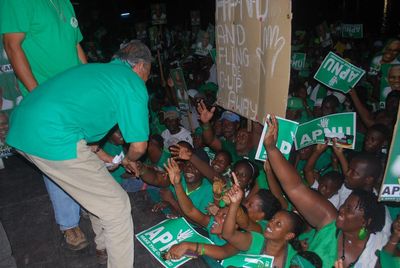
A Safe Pair of Hands
BY CLIVE LLOYD
Firstly, I extend my deepest and most sincere condolences to Rupert's family. May God continue to comfort you at this time of profound grief.
This is a very solemn moment for me, personally, although it's an honor, and a privilege, to pay tribute to Rupert Roopnaraine. A very well respected Guyanese sportsman, and an astute politician who had decades of experience in the political arena. Rupert was one of the finest and brightest Guyanese minds who attended the prestigious Cambridge University in the UK and Queen's College in Guyana.
I grew up with Rupert in Georgetown, Queenstown, and we played cricket day and night, along with his brother, whose nickname was Fishy. Fishy was a very good cricketer, and we were the pride of Queenstown. I have such precious memories of those days. Rupert was a natural. His tact and skills were like that of a diplomat. According to the cricketing analogy he was a safe pair of hands. Such was everyone's confidence in Rupert's ability to deal with a matter or issue, the confidence that we were in very safe and capable hands. He dealt with matters with style and aplomb.
Guyana has lost a great Guyanese, and I have lost a very dear friend. We shall miss his engaging smile, and his wonderful demeanor. Farewell, Rupert, my dearest friend. May God continue to comfort your family, and may your gentle soul rest in the peace of God and rise in glory.
Rupert’s Time Here With Us
By Trevor Boothe
Rupert Roopnaraine possessed the admirable qualities of having been a gentleman, a scholar, a politician on the streets and in the parliament, a sportsman, an author, an art connoisseur, a fine chef and a gracious host.
Rupert was above all else, a gentlemen of decency and integrity, who cared deeply for and about the wellbeing of his fellow human beings. It was my good fortune to have counted Rupert as a respected and valued friend over more than a quarter of century.
Forever will I hold dearly the memory of our friendship w recollections not only of his rigorous intellectual capacity, but also his grace and compassion.
I will do so with gratitude, with all that he shared with me, and all that I learnt from him. The world was a better place for Rupert’s time here with us, and we are the poorer for his passing.
My deepest condolences to the family. May Rupert’s soul rest in everlasting peace, even as the memory of him will endure for all time.

"A life well-lived"
By Deryck Murray
"A life well-lived" may be a cliched expression, but it is a simple, straightforward statement that aptly describes the legacy of Rupert Roopnaraine. For anyone who encountered him, however briefly or otherwise, Rupert left an indelible mark through his obvious intelligence and effervescent personality.
Rupert is a truly special friend -- a brother -- who approached every activity with great, overwhelming enthusiasm, nay passion! Cricket, bridge, politics, education, wine, food, culture, family and friendship .....
I first met Rupe when a Queen's Royal College (QRC) team from Trinidad & Tobago visited Queen's College (QC) in Guyana in 1959 to compete at cricket, football and athletics. A wonderful reciprocal arrangement which ostensively promoted a wider sporting rivalry but, more importantly, an opportunity for fostering life-long friendships and regional networks.I then had the privilege of following Rupert to Cambridge University in 1964, where he undertook the role of initiating me in the Cambridge culture and, more importantly, weaving me into his family circle.
During and immediately after our university years our personal and family relationships flourished to include my wife Maureen (we were married at the "Round Church" in Cambridge in 1967) and his wife Suraiya, his brother Bob and parents (who Rupe always referred to -- lovingly and respectfully -- as Penny and Crumps).
Our cricket -- and particularly WEST INDIES cricket -- is an obvious prevailing shared passion. This was a time of West Indies cricket "coming of age" whereas it was the time when, in England, university cricket was coming to terms with the reality of not being able to accommodate the recruitment of "mature student" cricketers to compete with seasoned county teams! In that context, Rupert was able to establish himself as the "Mr. Dependable" of the Cambridge bowling attack over his four years on the team. A bowler highly respected by team-mates and opponents alike.
Another of his passions was bridge at which he was mentoring Suraiya's development. However, there were times when his extreme passion proved counterproductive. Maureen was an avid observer and due to Suraiya being reduced to tears of frustration with Rupe's impatience -- often recorded in our scorecards as " rain stopped play"--- she decided to forego any opportunity to learn the game!
Maureen and I will always cherish our ties to the Roopnaraines, especially the times when we exchanged in person visits. Again, there were even times when too good a thing could be counter productive -- for me. Like when Rupe would question why I had so many shirts and he would magnanimously offer to relieve me of a couple! He obviously had impeccable taste but did he always have to choose my favourite shirts?
Nevertheless, Rupe's passion for the works of Baudelaire, Camus, Picasso; French film cuisine and wine was ever undiminished and always inspiring. As was his entry into the political arena and especially in his beloved Guyana. His legacy will live on.
Maureen joins in extending heartfelt condolences to his son Terry and daughter Alicia, his other surviving blood relatives as well as his wider chosen family. The happy memories we share of him will sustain us all. May he Rest in Peace and may Light Perpetual Shine Upon Him.
A life well lived ✝️
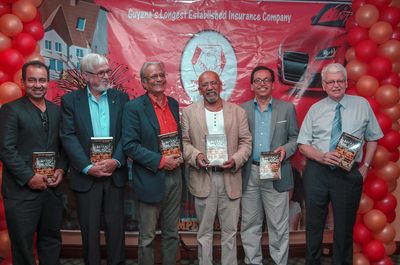
A Tribute to Rupert Roopnaraine
By Nigel Westmas
"Rupert Roopnaraine was, in many ways, a paradox. Possessed of a sharp and disciplined intellect –
especially at the well of classical literature – he also knew the intricacies of Guyanese political culture
and its cast of characters as few others do. He was a student at Queen’s College and one of those who
grew up in a Guyana in the 1950s/1960s where there were both the despair of political divisions and
the hopes for independence. He was also an excellent cricketer, awarded a Blue at Cambridge
University (for excellence in competition at the highest level), where he studied Modern Languages as a
Guyana scholar. Yet like many brilliant men, he can be curiously vulnerable in judging how others saw
him, or in reading the quiet calculations of those around him. It is part of what makes him human,
imperfect and all. His wit was sharp, even cutting, but it was never cruel. There was always a moral
seriousness beneath it, a sense that ideas matter because people always matter." Read more on Stabroek News.
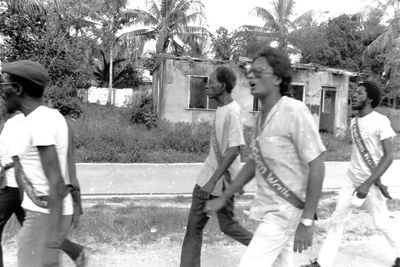
Farewell to a Great Friend, Brother and Revolutionary Compat
By Desmond Alli
"Dr. Roopnaraine not only loved the Arts, he was also a collector. He always responded to invitations
of the Guyana United Artists (GUA) along with Ms. Jocelyn Dow, their support helped to develop
many young Guyanese as artists.
I remember well at an exhibition held at the Venezuelan Cultural Centre in Camp Street, Brother
Rupert as we called him, brought some friends along and they bought out most of the art exhibits
and left with their hands filled. For years we recounted that day!" Read more on Stabroek News.

For his Contributions to the Restoration of Democracy
By Dr. Vishnu Bisram
"As I learnt, he battled illness with fortitude, dignity, and bravery just as he lived. No amount of
mental and physical torture deterred him from the relentless struggle to restore democracy to the
homeland which eventually came in 1992 after 24 years of authoritarian rule. Rupert, as we called
him, was a man of impeccable integrity. His honesty was (is) in the same league as Cheddi and
Janet Jagan, Boysie Ramkaran, Eusi Kwayana, Omowale, Fenton Ramsahoye, Ravi Dev, Baytoram
Ramharack, Vassan Ramracha, among others." Read more on Stabroek News.
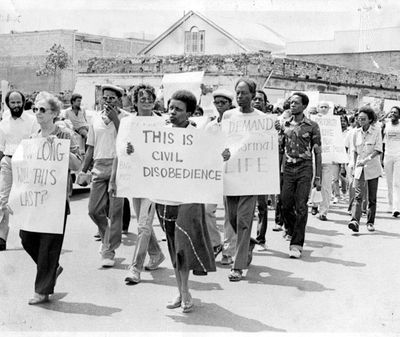
When the shield wears out, the framework still remains.
By Natalia Kanem
‘When the shield wears out, the framework still remains.’
So asserts the Akan proverb, and so shall it be with Rupert, a man of great intellect and an intelligent exemplar of integrity who gave selflessly to his country and to Caribbean society, and who held his friends close.
How fortunate we were, to spend time in his company debating the issues, exclaiming over the beauty of some small piece of nature, laughing about whatever foibles of the day, or just quietly reading in his presence.
He never gave up on the proposition that we all must do our bit to turn people’s misfortunes around, by taking action in the here and now. May we take that framework as his guidance for shaping a better world.
May his gentle Soul rest in everlasting Peace. Amen!
REMEMBRANCE: RUPERT ROOPNARAINE Reflections on Meeting, Know
By Ray Kril
In memory of a man whose life was itself a political act — generous, visionary, and unrelenting in its love for justice.
It is not often that you meet someone fifty-one years ago and, across all those years, sustain a relationship of creative work, shared purpose, and deep love. That was possible because of Rupert Roopnaraine's extraordinary power — a force of personality rooted in commitment, in the generosity with which he shared ideas, in the sincerity with which he believed in and learned from the people around him. From the moment of our first meeting, I sensed that our lives would intertwine.
Meeting at Cornell
Late in 1975, I was appointed Coordinator of the Cornell Cinema Program at Cornell University, where I first encountered Rupert. He served on the Board of Advisors for Cornell Cinema and held a position as professor and chair in the English Literature faculty. Our bonding was immediate and instinctive. I was struck by the breadth and depth of his knowledge — his progressive, searching analysis of cinema, visual art, and literature — and he, in turn, was drawn to my film productions and to my conception of film as an instrument of social change. I had recently completed work in the USSR and had just finished a short dramatic film featuring the anarchist Emma Goldman. It seemed we had found each other across a shared landscape of ideas.
So began regular dinners together, long discussions on Marxism, and rigorous political analysis of film. Rupert introduced me to the new cinema emerging from Latin America and Cuba — a revelation. And he introduced me to Guyana, the country of his birth and upbringing. I knew nothing of that place, but through his words I gained a deep appreciation for its anti-colonial politics, its literature, and its culture. He spoke at length about the pivotal year of 1953, when Guyana had elected a communist government committed to home rule — a government soon dismantled by British invasion. He pressed upon me a book of poetry from that era: Poems of Resistance by Martin Carter. A seed was planted.
The Victor Jara Collective
Out of those conversations, Rupert, along with myself and his student Lewanne Jones, founded what we called the Victor Jara Collective — the name itself Rupert's suggestion, honouring the Chilean folk singer who was murdered in the military coup of 1973, whose music had been a political act in solidarity with workers and human dignity. The name was, in effect, a manifesto: a declaration of what our collective would stand for and pursue. My longtime colleague Susumu Tokunow, with whom I had worked in California, was invited to join and accepted, completing a solid and committed production team.. Rupert would resign his position at Cornell, I took a years leave and together with Susumu and Lewanne we left Ithaca New York for Guyana to make a film about 1953 Guyana anti colonial struggle with the poetry of Martin Carter as the red thread.
The Terror and the Time
What followed was the making of a film with no financial backing beyond our own savings — a struggle unlike any I had known. Through Rupert's many old connections and the fact that he had returned to Guyana we managed to obtain a variety of resources. There came a moment when I nearly lost faith entirely. It was Rupert who steadied me. He spoke with a quiet certainty I have never forgotten, telling me that this film might well prove to be among the great accomplishments of our lives. Finally after several months of shooting the dictatorial government of Forbes Burnham was about to close down the production and the collective minus Rupert moved all the material from Guyana to finish the film in New York,
The years have borne out Rupert’s words of encouragement to me. The Terror and the Time continues to be screened and discussed to this day, and is now being restored to a new 4K print. It has followed me through life like a companion. And Guyana itself has become one of my adopted countries. Over the decades, I have returned to make nine more films there, produce media for two Working People's Alliance election campaigns, and collaborate on three films with Rupert's son Terry. The circle of life, as they say, continues to turn.
A Loss, and a Legacy
Sorrow fills my heart at his passing — but so does joy: the joy of having been part of his remarkable life, of having loved him, of having shared with him the overlapping creative journey that gave this passage through life its meaning and its soul.
I will miss him. But I think Guyana will miss him more.
Rupert Roopnaraine is, truly, a Guyanese legend. Tragically, Guyana needs his insights now more than ever, as an oil oligarchy casts its long shadow over the land he loved and fought for. Yet as a legend, he has inspired many — and those who carry his spirit forward must, and will, continue the struggle for a new Guyana that protects its environment and provides equality for all.
